


STM32F767 · PB8 ↔ MPU6050 · SCL
Simulate the whole system, not just the chip.
Simulator86 runs the firmware you already ship on every controller in your product, together, from your scripts, your CI or your editor's AI agent.
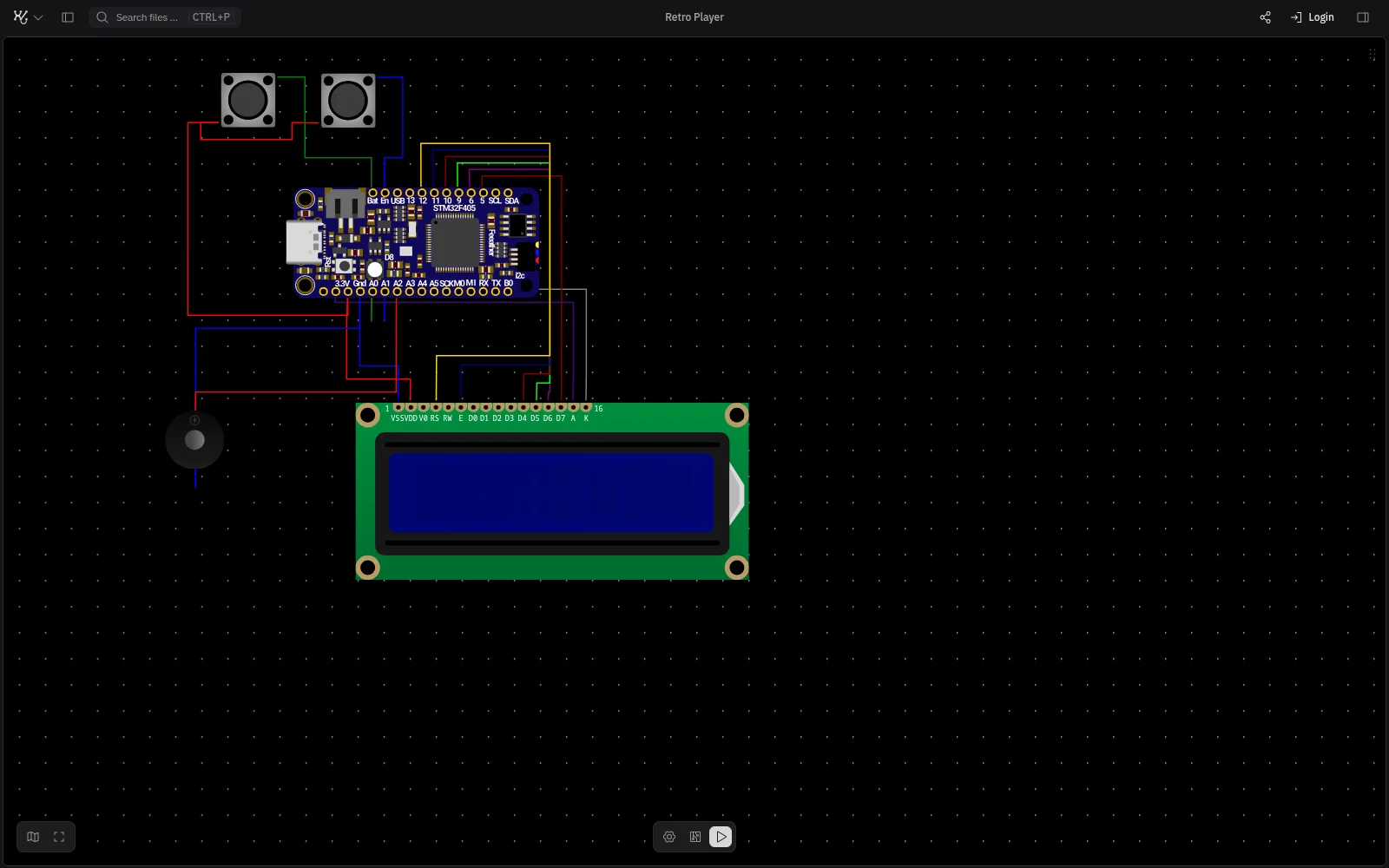 Autonomous inspection drone
Open
Components
Suggested Files
No matching files or actions
RunningRealtimeSimulation
~/drone $ west build -b nucleo_f767zi flight-controller-- west build: generating a build system-- Board: nucleo_f767zi-- Configuring done[1/142] Preparing syscall dependency handling[97/142] Building C object CMakeFiles/app.dir/src/imu.c.obj[98/142] Building C object CMakeFiles/app.dir/src/main.c.obj[142/142] Linking C executable zephyr/zephyr.elfMemory region Used Size Region Size %age Used FLASH: 38412 B 2 MB 1.83% RAM: 9216 B 512 KB 1.76%Build finished: flight-controller/build/zephyr/zephyr.elf~/drone $
/* Flight controller: attitude loop at 400 Hz on the STM32F767. */
#include <zephyr/kernel.h>
#include <zephyr/drivers/i2c.h>
#include "attitude.h"
#include "imu.h"

#define LOOP_HZ 400

static const struct device *i2c = DEVICE_DT_GET(DT_NODELABEL(i2c1));

int main(void)
{
    struct imu_sample s;

    if (!device_is_ready(i2c)) {
        return -ENODEV;
    }

    while (1) {
        imu_read(i2c, &s);
        attitude_update(&s);
        k_sleep(K_USEC(1000000 / LOOP_HZ));
    }
}#include "imu.h"
#define MPU6050_ADDR 0x68
#define ACCEL_XOUT_H 0x3B
int imu_read(const struct device *i2c, struct imu_sample *s)
{
uint8_t raw[14];
int err = i2c_burst_read(i2c, MPU6050_ADDR, ACCEL_XOUT_H,
raw, sizeof(raw));
if (err) {
return err;
}
s->ax = (int16_t)(raw[0] << 8 | raw[1]);
s->ay = (int16_t)(raw[2] << 8 | raw[3]);
s->az = (int16_t)(raw[4] << 8 | raw[5]);
return 0;
}CONFIG_I2C=y
CONFIG_SPI=y
CONFIG_SERIAL=y
CONFIG_GPIO=y
CONFIG_LOG=y// Safety monitor: raises FAULT if the flight controller goes quiet.
#include "pico/stdlib.h"
#define HEARTBEAT_PIN 15
#define FAULT_PIN 16
#define TIMEOUT_US 10000
int main(void)
{
gpio_init(HEARTBEAT_PIN);
gpio_init(FAULT_PIN);
gpio_set_dir(FAULT_PIN, GPIO_OUT);
uint64_t last = time_us_64();
bool level = gpio_get(HEARTBEAT_PIN);
while (true) {
if (gpio_get(HEARTBEAT_PIN) != level) {
level = !level;
last = time_us_64();
}
gpio_put(FAULT_PIN, time_us_64() - last > TIMEOUT_US);
}
}//! Telemetry: forwards flight state from UART to the ground link.
#![no_std]
#![no_main]
mod link;
use embassy_executor::Spawner;
use esp_hal::uart::{Config, Uart};
#[esp_hal_embassy::main]
async fn main(_spawner: Spawner) {
let p = esp_hal::init(Default::default());
let mut uart = Uart::new(p.UART1, Config::default())
.unwrap()
.with_rx(p.GPIO6)
.with_tx(p.GPIO7)
.into_async();
let mut frame = [0u8; 32];
loop {
let n = uart.read_async(&mut frame).await.unwrap();
link::send(&frame[..n]).await;
}
}# Autonomous inspection drone
Three controllers on one airframe, simulated together:
- flight-controller: STM32F767, Zephyr
- safety-monitor: RP2350, pico-sdk
- telemetry: ESP32-C3, Rust + Embassy/* Flight controller: attitude loop at 400 Hz on the STM32F767. */
#include <zephyr/kernel.h>
#include <zephyr/drivers/i2c.h>
#include "attitude.h"
#include "imu.h"
#define LOOP_HZ 400
static const struct device *i2c = DEVICE_DT_GET(DT_NODELABEL(i2c1));
int main(void)
{
struct imu_sample s;
if (!device_is_ready(i2c)) {
return -ENODEV;
}
int64_t next = k_uptime_ticks();
while (1) {
imu_read(i2c, &s);
attitude_update(&s);
next += k_us_to_ticks_ceil64(1000000 / LOOP_HZ);
k_sleep(K_TIMEOUT_ABS_TICKS(next));
}
}Live signals
STM32F767 · PB9 ↔ MPU6050 · SDA
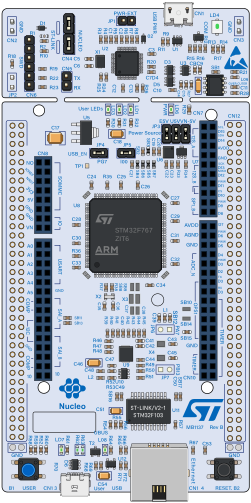 Primary flight controller STM32F767
 Telemetry ESP32-C3
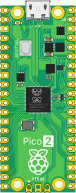 Safety monitor RP2350
 Motion MPU6050
 Altitude BMP280
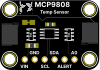 Thermal MCP9808

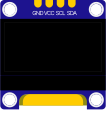 Status SSD1306
%20rotate(49)%20scale(10.6)'%3e%3cstop%20stop-color='%233B3C3C'/%3e%3cstop%20offset='0.34'%20stop-color='%23242525'/%3e%3cstop%20offset='0.76'%20stop-color='%23111212'/%3e%3cstop%20offset='1'%20stop-color='%23070707'/%3e%3c/radialGradient%3e%3cradialGradient%20id='buzzer-port'%20cx='0'%20cy='0'%20r='1'%20gradientUnits='userSpaceOnUse'%20gradientTransform='translate(5.35%205.25)%20rotate(48)%20scale(3.2)'%3e%3cstop%20stop-color='%23505151'/%3e%3cstop%20offset='0.42'%20stop-color='%23292A2A'/%3e%3cstop%20offset='0.82'%20stop-color='%230A0B0B'/%3e%3cstop%20offset='1'%20stop-color='%23020202'/%3e%3c/radialGradient%3e%3clinearGradient%20id='buzzer-rim'%20x1='3'%20y1='1.2'%20x2='8.6'%20y2='10.8'%20gradientUnits='userSpaceOnUse'%3e%3cstop%20stop-color='%23747575'/%3e%3cstop%20offset='0.28'%20stop-color='%23303131'/%3e%3cstop%20offset='0.72'%20stop-color='%23090A0A'/%3e%3cstop%20offset='1'%20stop-color='%23242525'/%3e%3c/linearGradient%3e%3cfilter%20id='buzzer-shadow'%20x='-14%25'%20y='-14%25'%20width='128%25'%20height='145%25'%20color-interpolation-filters='sRGB'%3e%3cfeDropShadow%20dx='0'%20dy='0.24'%20stdDeviation='0.24'%20flood-color='%23000'%20flood-opacity='0.5'/%3e%3c/filter%3e%3c/defs%3e%3c!--%20Familiar%20round%20molded%20body,%20with%20only%20restrained%20material%20depth%20added.%20--%3e%3ccircle%20data-part='body'%20cx='6'%20cy='6'%20r='5.72'%20fill='url(%23buzzer-body)'%20stroke='%23030303'%20stroke-width='0.42'%20filter='url(%23buzzer-shadow)'/%3e%3ccircle%20cx='6'%20cy='6'%20r='5.25'%20stroke='url(%23buzzer-rim)'%20stroke-width='0.3'/%3e%3cpath%20d='M2.15%203.48A4.7%204.7%200%200%201%206.85%201.36'%20stroke='%23A2A3A2'%20stroke-width='0.17'%20stroke-linecap='round'%20opacity='0.42'/%3e%3cpath%20d='M10.55%207.05A4.7%204.7%200%200%201%205.05%2010.6'%20stroke='%23020202'%20stroke-width='0.22'%20stroke-linecap='round'%20opacity='0.72'/%3e%3c!--%20Recessed%20sound%20opening,%20matching%20the%20scale%20and%20placement%20of%20the%20old%20art.%20--%3e%3ccircle%20data-part='sound-port'%20cx='6'%20cy='6'%20r='2.08'%20fill='url(%23buzzer-port)'%20stroke='%23030303'%20stroke-width='0.28'/%3e%3ccircle%20cx='6'%20cy='6'%20r='1.66'%20stroke='%23777878'%20stroke-width='0.12'%20opacity='0.3'/%3e%3cellipse%20cx='5.48'%20cy='5.35'%20rx='0.64'%20ry='0.28'%20fill='%23B8B9B7'%20opacity='0.11'%20transform='rotate(-18%205.48%205.35)'/%3e%3c!--%20Molded%20polarity%20marker%20retained%20from%20the%20original%20component.%20--%3e%3ccircle%20cx='6'%20cy='2'%20r='0.9'%20fill='%23171818'%20stroke='%235E5F5F'%20stroke-width='0.13'/%3e%3cpath%20d='M5.52%202H6.48M6%201.52V2.48'%20stroke='%23A7A8A7'%20stroke-width='0.18'%20stroke-linecap='round'/%3e%3c/svg%3e) Fault tone
Fault tone Fault state
Used by engineers at



Supported platforms
 FreeRTOS
 Embassy
See it run before you talk to anyone. Hardware should never block firmware.
Open a complete system in your browser, press run, and watch every controller, sensor and display work together. No account or board needed.
An AI plays Snake
An ESP32-C3 asks an AI model for every move over TLS 1.3 from the chip, with two displays, tilt controls and a buzzer.
- Rust
- Embassy
Two controllers, one bus
Two controllers share sensors, a display and a serial link.
 ESP-IDF
- Rust
Doom on RP2040
The full game running unmodified on a simulated RP2040, drawn to a colour display.
 pico-sdk
Before an evaluation.
What engineering teams usually need to establish first.
What is Simulator86?
Simulator86 is a programmable simulation environment for developing, testing, and validating embedded systems before relying on physical hardware.
Can Simulator86 run our real firmware?
Yes. Simulator86 runs compiled firmware inside a virtual hardware environment, allowing teams to test the software they intend to ship.
Does Simulator86 support our framework and libraries?
Yes. Simulator86 is framework- and library-agnostic: if your firmware runs on the real supported chip, it runs on Simulator86.
What can embedded teams use Simulator86 for?
Teams use Simulator86 to develop firmware, reproduce difficult failures, automate testing, and validate system behavior at scale.
Which devices and systems can Simulator86 support?
Simulator86 supports a growing range of embedded architectures, devices, and connected systems. We evaluate each target system to confirm the right simulation coverage.
How does Simulator86 fit into an engineering workflow?
Teams can use Simulator86 interactively, integrate it into automated workflows, or connect it to AI engineering tools through the IDE, SDK, and MCP.
How do we evaluate Simulator86 for our product?
Start with a technical evaluation. We’ll review your firmware, target system, and engineering goals to determine how Simulator86 can support your team.







Tell us what's on your board.
Book a call with one of our engineers. Tell us which controllers and parts your product uses, and we'll show you what we already support and tell you plainly what we don't yet.